
Roadwork

Roadwork: The movement that put women’s culture on the road.
RoadworkCenter.Org
View the Website
Roadwork Oral History & Documentary Project
Facebook Page
A History of Roadwork
Smithsonian Center for Folklife & Cultural Heritage
View Youtube Video
“There and Back Again” An Audiovisual Journey Into Roadwork, 1978-2018
By Amy Horowitz, Introduction Susan J. Erenrich
Read Article (pdf)
Washington Post Articles
Laying the Roadwork for Sisterfire
June 26, 1982
By Richard Harrington
Read Article
The Spread of Sisterfire
June 27, 1987
By Kara Swisher
Read Article
Sisterfire at Six
June 26, 1988
By Claudia S and Lin
Read Article
Sisterly Celebration
June 27, 1983
By Elizabeth Alex
Read Article
‘Sisterfire” Event Grows into Equestrian Center
June 25, 1987
By Freddie A. Brown, Jr.
Read Article

The decades of the 1970s and 1980s are often dismissed, even though they were years transformed by the exuberance of women’s movements; the floodgates of cultural expression opened by lesbian/gay movements; the urgent responses to violations of human rights, international social justice and nuclear madness; the continuities of African-American civil rights movements and labor movements of earlier decades.
 Drawing inspiration from the foundation built during the civil rights and labor movements Roadwork Inc. emerged in 1978 as a national and international multiracial, cross-cultural women’s arts organization. Over the next 15 years, Roadwork was at the forefront of coalition efforts based on artistic collaboration among diverse communities.
In 2000, Roadwork expanded its focus to the role of culture and art in conflict zones. In keeping with its expanded mission, the organization assumed a new name, Roadwork Center for Cultures in Disputed Territory. We see disputed territory as not only encompassing geo-political conflict but also addressing issues of race, gender, sexual orientation, class and disability.
Roadwork houses the Living Jerusalem Project, an engagement among Israeli, Palestinian, and U.S. artists, activists and scholars. We initiated the Protest Music as Responsible Citizenship project that began with a four-day dialogue between Harry Belafonte, Pete Seeger, Bernice Johnson Reagon and Holly Near.
Roadwork has initiated a digital archive project. The purpose of this archive is to gather together personal recollections and artifacts from artists, organizers and audiences who participated in the Roadwork experience during the 1970s and 1980s. We are committed to open access to the archive so that connections across boundary lines can continue to be made in the future. In addition to the archive project, we are initiating the Roadwork Oral History and Documentary Project.
We will accomplish our mission by acquisition, preservation and making available materials that document the history of the organization since its inception in 1978. This collection will be initially focused on but not limited to artifacts, documents, recordings and written accounts. The scope of the collection will be elastic enough to include written and oral personal histories via audio or video recording.
Pursuit of this mission provides us a source of grassroots and multiracial women’s memories that will offer a creative and life-affirming vision for future generations of activists and those trying to reveal the truth of what came before.
Other Articles
Sisterfire 2018
Read Articles
Amy Horowitz: From B’nai B’rith Girls to ‘Sisterfire’
June 14, 1984
By Janis Kaplan
Washington Jewish Week
Read Article
Sisterfier ’84 Festival
Women’s Culture: ‘Playing with Fire’
By Carol Jones
Read Article

Some Factors in the Equation
By Amy Horowitz
Chapter in We Who Believe in Freedom
Sweet Honey Book
Read Article
The 1987 Sisterfire Marketplace incident
and Roadwork’s response:
Violence Against Lesbians at Sisterfire
By Lin Daniels and Myriam Fougere
October 1987
Off Our Backs, A Woman’s NewsJournal
Read Article
Roadwork Responds…
October 1987
Off Our Backs, A Woman’s NewsJournal
Read Article
Sisterfire
Sisterfire 2018
Sisterfire 2019
Sisterfire 2020
Sisterfire 2021
Sisterfire 2022
Sisterfire 2023
Sisterfire 2024
Resources
Recent Sisterfires Available for Viewing Online
2019 Sisterfire Showcase
2020 Sisterfire SongTalk
2021 Languages of Home and Diaspora: Nourishing Palestine in Food and Verse
2022 Sisterfire @40 Fired Up to Transform the Future
2023 Sisterfire Love Songs
The Sisterfires That Sprouted While Roadwork/Sisterfire Hibernated
Feminism at the Apollo: Women of the World Festival Debuts Stateside
Just Seeds Sisterfire
Sisterfire: Black Womanist Fiction and Poetry
Sisterfire - Wearing Gay History
Sisterfire Festival, NYT; July 1985
2018 Sisterfire Reunion
Artist-activists in their 20-40s joined with artists in their fifties, sixties, and seventies. Together they co-created and shared a 2018 Sisterfire stage much as a young Toshi had with elder Elizabeth Cotten in 1983, like Moving Star Hall Singers with Casselberry and Dupree in 1984, and like June Jordan with Tracy Chapman in 1987. As I stood in the congregation, I sang to the Sisterfire artist and organizer ancestors, Odetta, Ronnie Gilbert, Ampara Ochoa, June Jordan, Shirley Childress Johnson, Flora Molton and Elizabeth Cotten. Urvashi Vaid, Gail Christian, Kathy Glimn, and Ivy Young. It was not nostalgia — it was radical reverie.
Final in essay: Artist-activists in their 20-40s joined with artists in their fifties, sixties, and seventies. Together we co-created and shared a 2018 Sisterfire stage that resonated with those stages from the past.. As I stood in the congregation, I sang to the Sisterfire artist and organizer ancestors. It was not nostalgia — it was radical reverie.
I can remember the spring of 1982: The Roadwork house at 1475 Harvard Street NW was buzzing with activity. The phones were ringing off the hook with producers checking in on national tour dates for Sweet Honey In The Rock, Cris Williamson, June Jordan, June Millington.
Sisterfire grew from a one-day event in a Takoma Park field to two days with three stages at the Upper Marlboro Equestrian Center. Sisterfire presented Alice Walker, Tracy Chapman, Hazel Dickens, Elizabeth Cotten, and Ronnie Gilbert. Alicia Partnoy, Moving Star Hall Singers, Hala Deeb Jabour, and Sara Alexander shared stages with Sweet Honey, Holly Near, Cris Williamson and Alix Dobkin. And the audiences, marketplace vendors, and volunteers reflected this diversity.
Roadwork 40th Anniversary Concert
Sisterfire Rocks The Capital: Thousands To Celebrate Roadwork’s 40th Anniversary In D.C.
Sisterfire, a D.C. Women’s Festival From the ’80s, Is Being Resurrected This Weekend
Sisterfire 2018, interview with Alexis De Veaux
Sisterfire Rocks The Capital: Thousands To Celebrate Roadwork’s 40th Anniversary In D.C.
Sisterfire, a D.C. Women’s Festival From the ’80s, Is Being Resurrected This Weekend
Sisterfire Performers
1982
Women of the Calabash
Retumba Con Pie
Holly Near
Sweet Honey In The Rock
Michelle Parkerson Alexis DeVeaux
The Harp Band
Cris Williamson
Sign language Shirley Childress, Susan Freundlich, Ysaye Barnwell
1983
Meg Christian,
Teresa Trull
Elizabeth Cotten
Sweet Honey in the Rock
Women of the Calabash
Toshi Reagon
Other Performers
Chi Hughes
In Process
Marybeth Miller
Jennifer Justice
June Jordan and Adrienne Torf
Niani Kilkenny
Lifeline
Yolanda Mancilla
IBIS
Shirley Childress Johnson
Edwina Lee Tyler and a Piece of the World
Risa Shaw
Cris Williamson with Tret Fure, Cam Davis, Carrie Barton
Lynette Taylor
Ethel Raim
Judy Reagan
Toshi Reagon
Victoria Payton
First World Dance Theater
Sandra Gish
Robin Flower Band
Photo Gallery
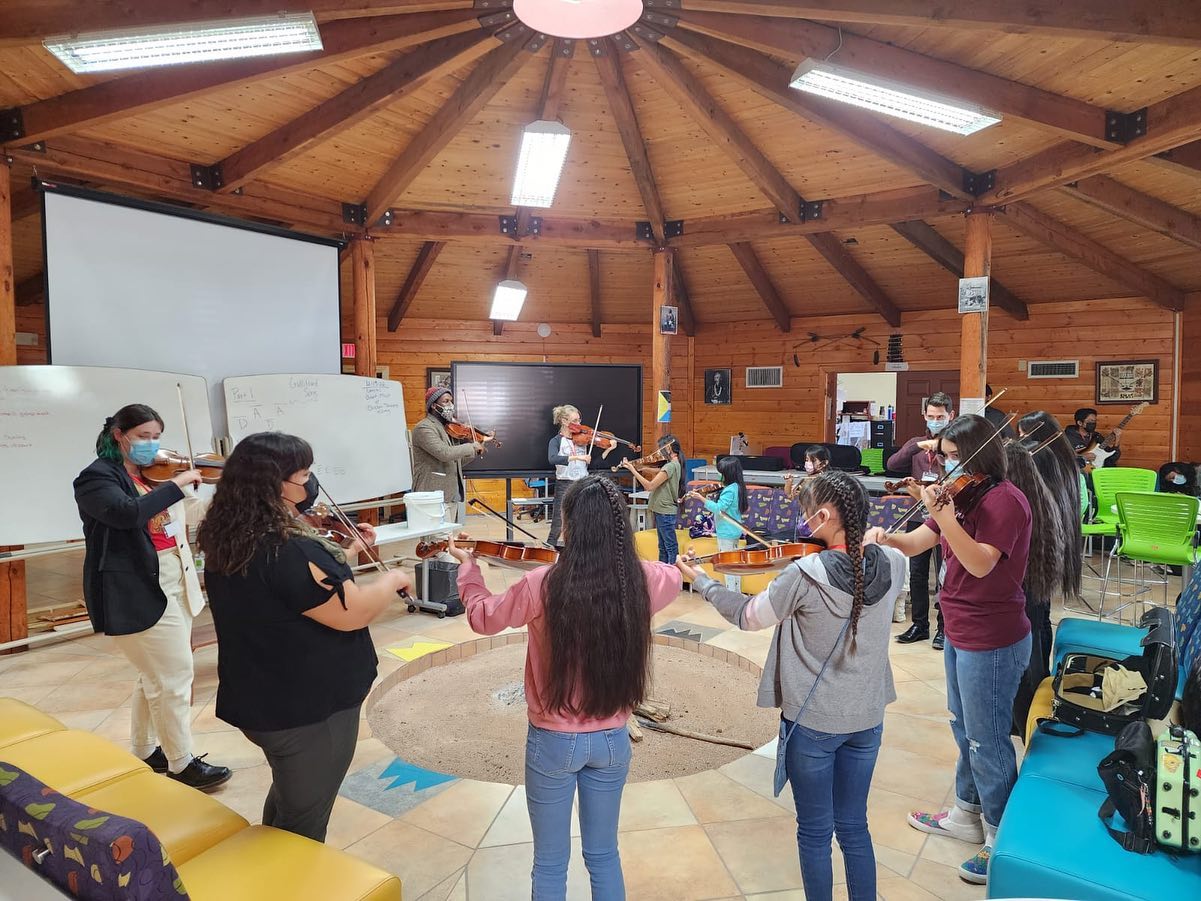
The Heartbeat Music Project learns traditional Diné songs on violin in the hogan.

Photo of Smithsonian Folklife Festival Ad in the Washington, D.C., Metro. Photo Credit, Amy Horowitz.

About Roadwork. Courtesy, Roadwork.
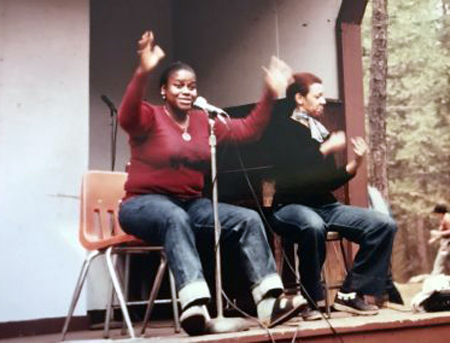
Dr. Bernice Johnson Reagon (Of Blessed Memory) speaks about the importance of coalition at the West Coast Women’s Festival. With Dr. Shirley Childress Johnson (Of Blessed Memory). Photo Credit: Amy Horowitz
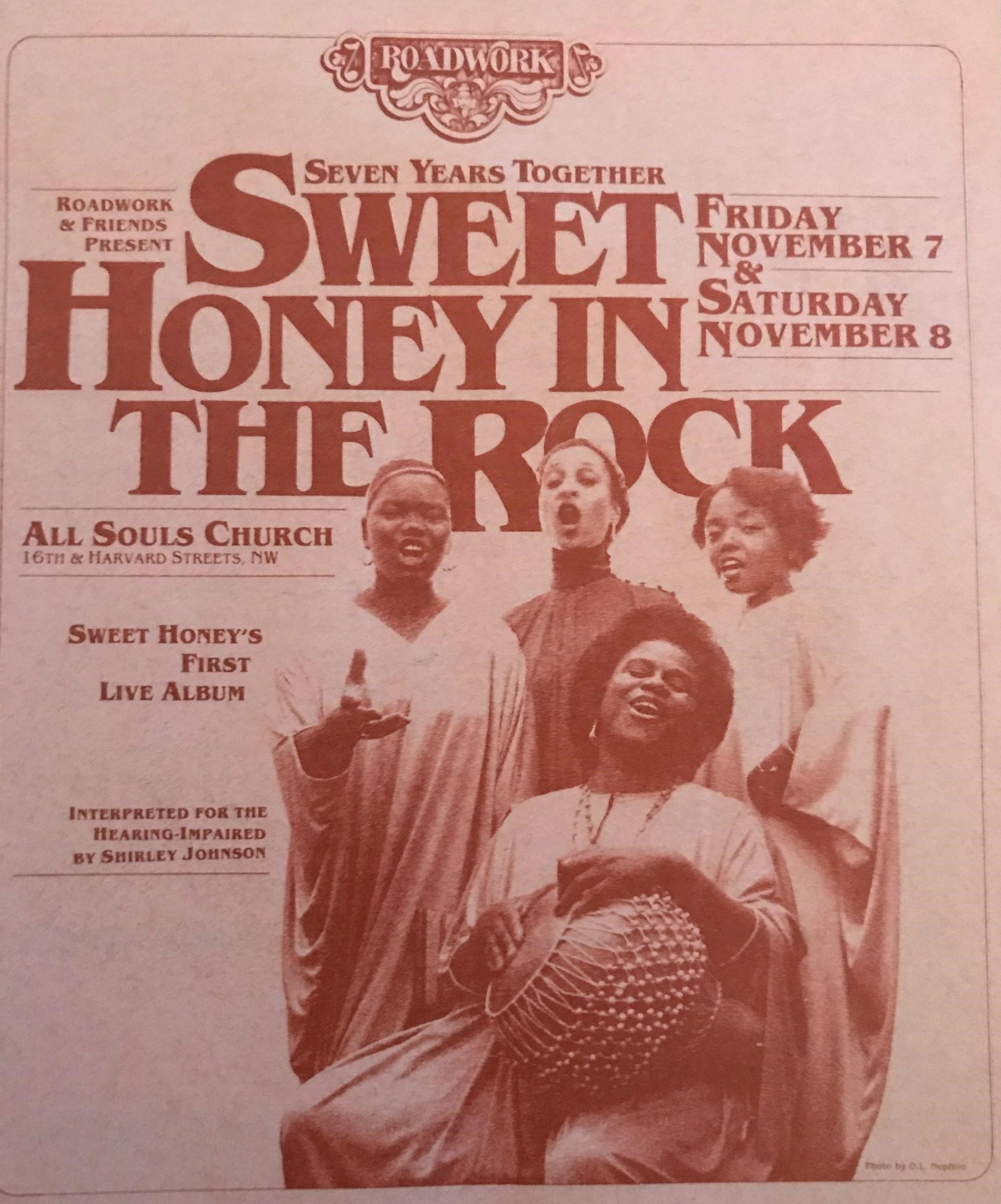
Sweet Honey In The Rock 7th anniversary Concert Flyer. Flyer design: Sarna Marcus. Courtesy, Roadwork.
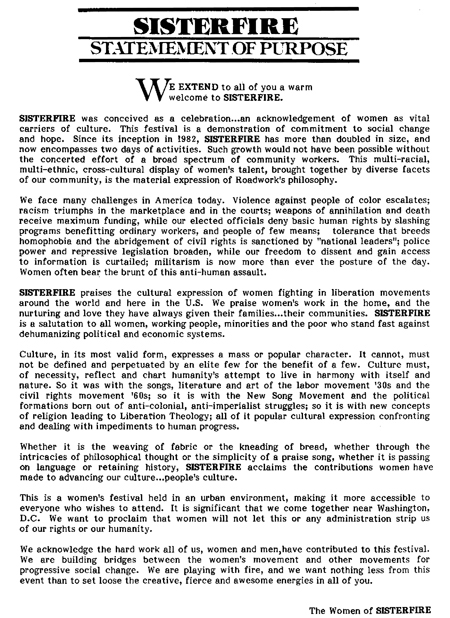
Statement of Purpose. Courtesy, Roadwork.
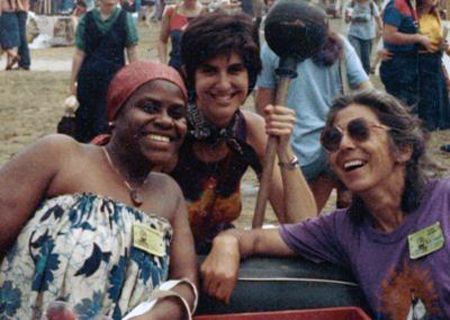
Bernice Johnson Reagon, Amy Horowitz, and Toshi Seeger at the Clearwater Hudson River Revival 1970s. Photo Credit, Amy Horowitz.
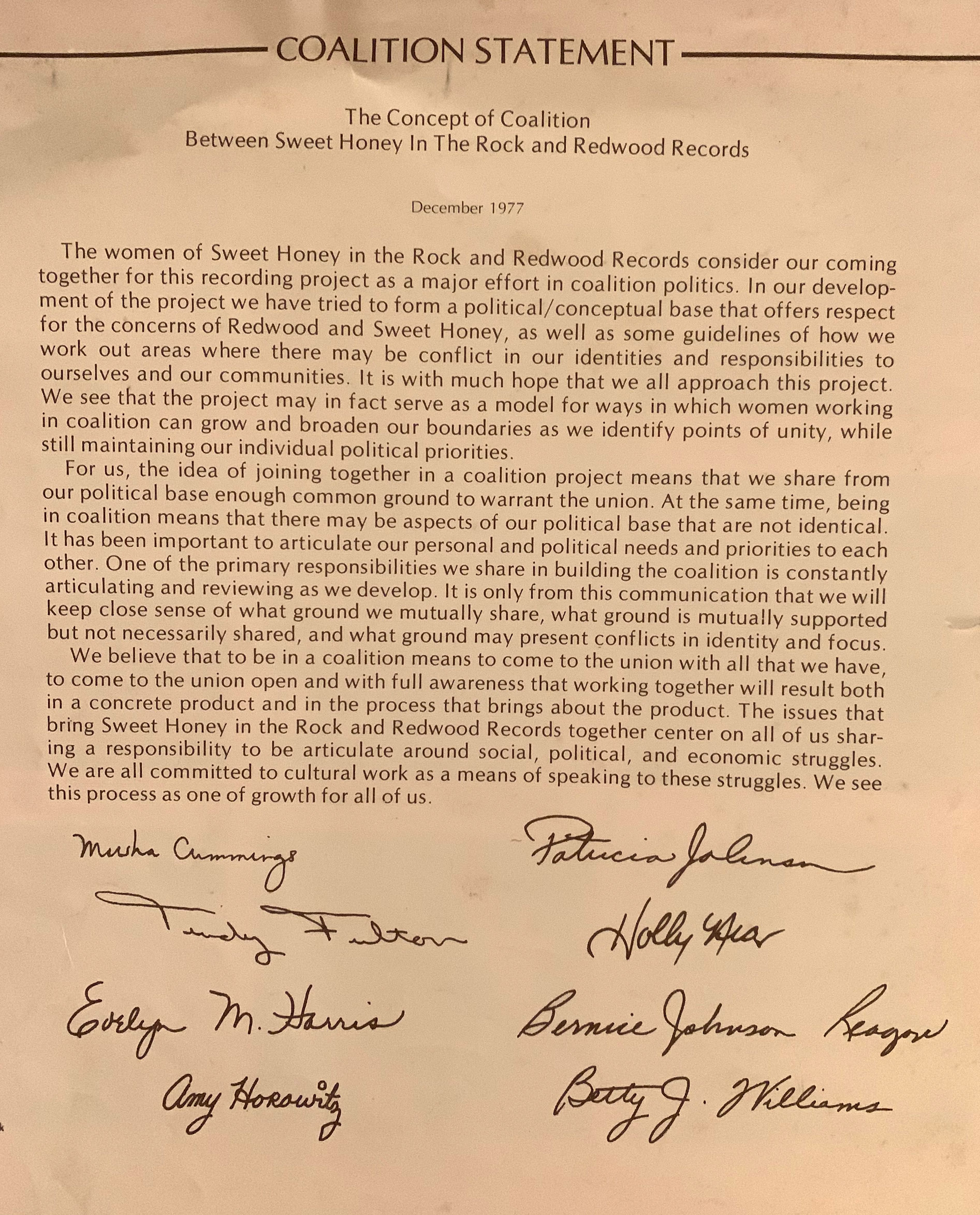
Early Coalition Statement: Drafted by Bernice Johnson Reagon and Amy Horowitz to outline the framework for a working coalition Between Sweet Honey In The Rock and Redwood Records. Courtesy, Roadwork.
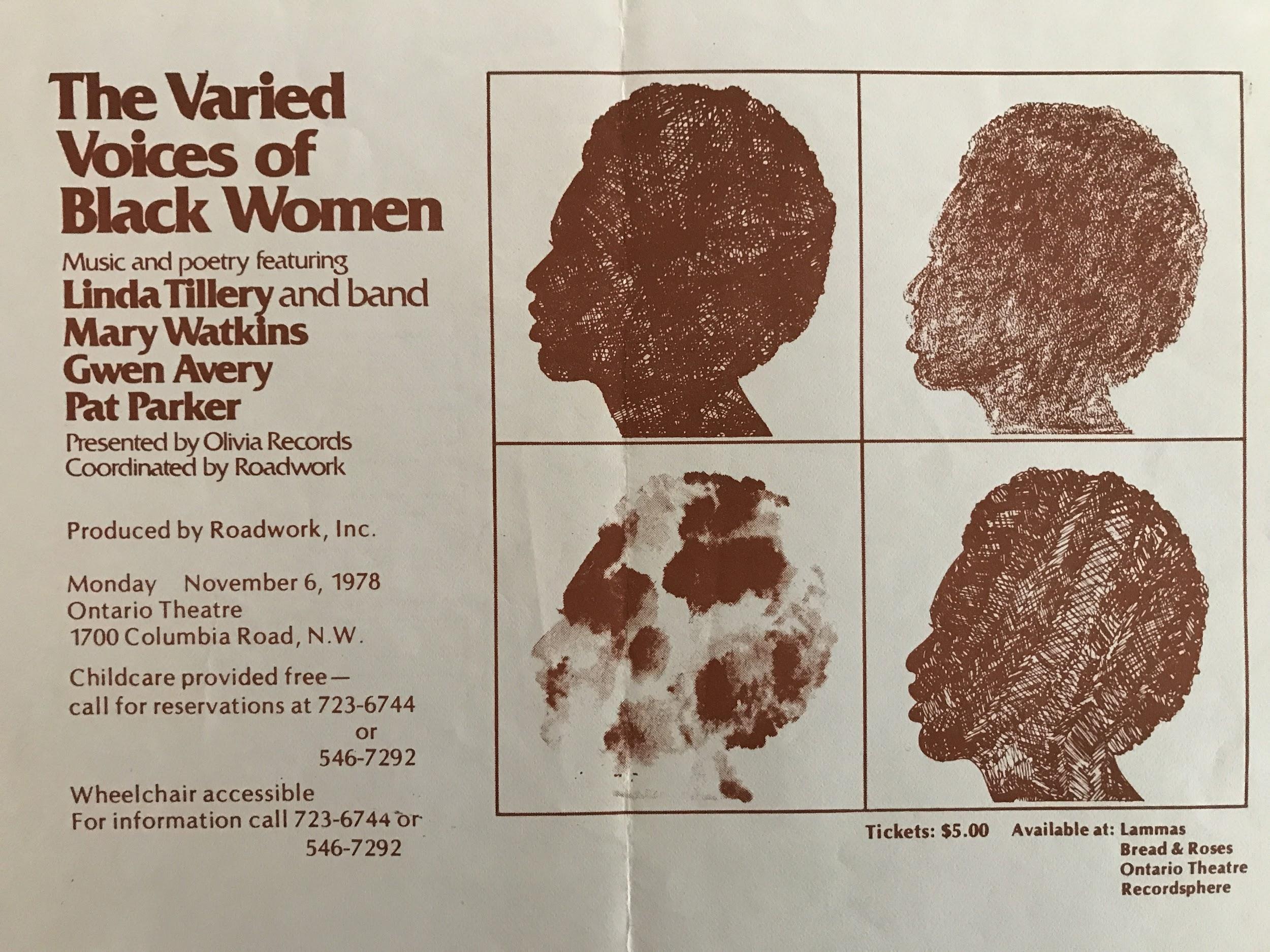
The Varied Voices of Black Women Flyer. Courtesy, Roadwork.

Laying the Roadwork for Sisterfire

Roadwork Ahead
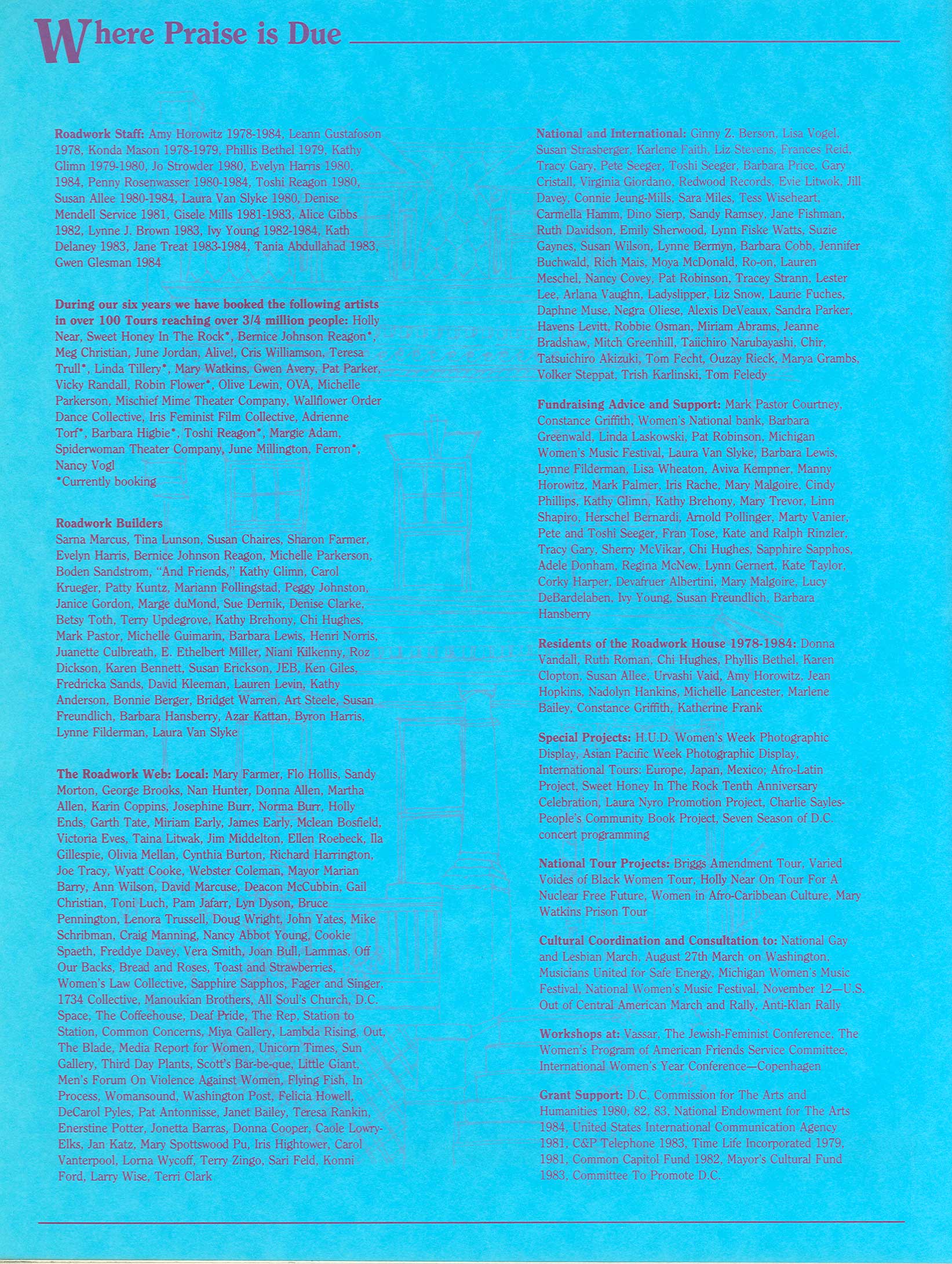
Sisterfire Back Cover Credits